
If Susana Attías’s current works are both very uninhibited and very vigorous, as an expression of a feeling of self-assurance and mastery over the resources of her painting craft, it is due not only to her sensibility and talent, but also to the entire development of her valuable preceding experience.
Susana Attías’s painting was (and still is, albeit in a different way) a torrential painting: a true and extraordinary torrent of energy, sensibility, imagination, and nerve that flows impetuously onto the canvas, on the verge of overflowing.
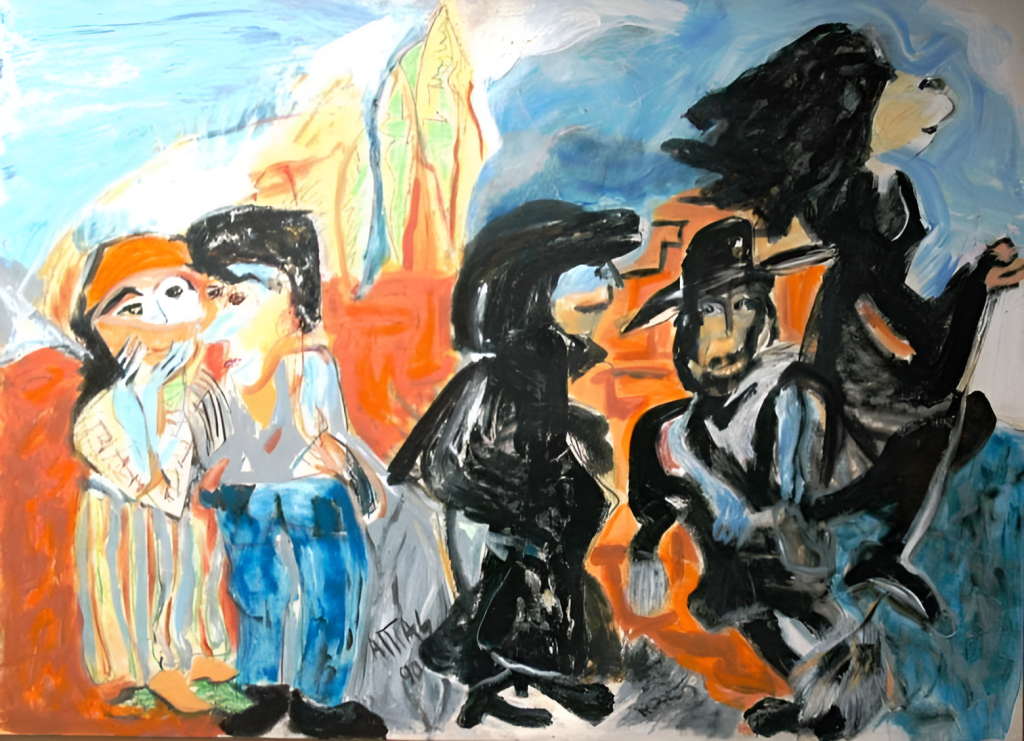
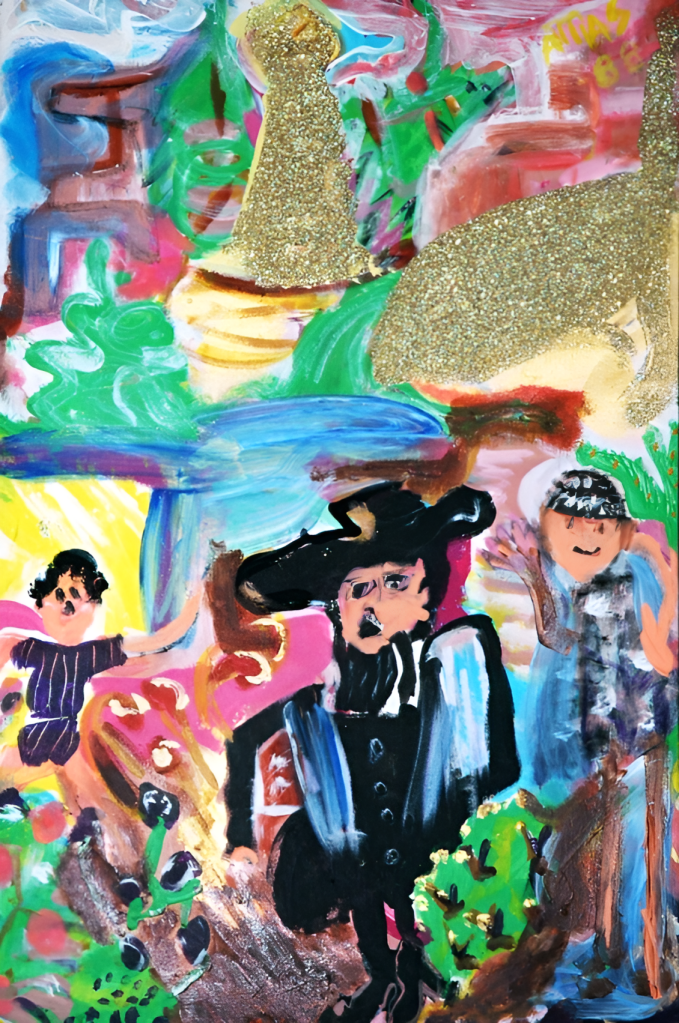
When looking at Susana Attías’s works, we are assailed by a great profusion of forms and vibrant colors, painted with utmost spontaneity, directly onto the canvas, without sketches or prior studies, and without hesitation, as if emerging from a single sudden impulse.
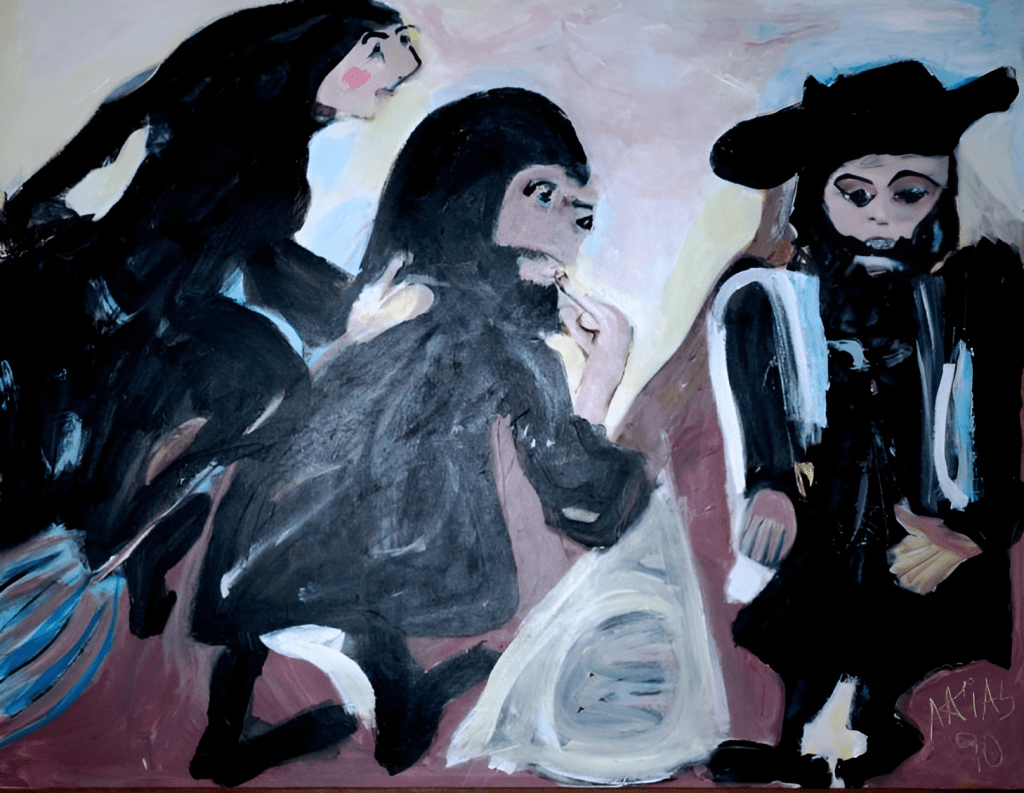
All that baroque and exuberant turbulence seemed to slow down a bit when the artist, perhaps with the purpose of self-control, created a series of paintings inspired by classical Japanese prints. These, despite being very free interpretations, allowed her to try another type of experience in the structuring of her works, more synthetic and with great economy of means: and that Japanese stage helped her to lose the “horror vacui” of her preceding production. From that stage derive others that now culminate in the works of this exhibition at La Galería Okyo, with their characters in dark suits. In these recent paintings, strength is concentrated, instead of being dispersed as in earlier stages. From Dionysian agitation and visual extravagance, the artist now moves to the severity of her large central forms, simple, austere, but perhaps more powerful than her previous overflows: Instead of the extroversion of formal language, there is rather its introversion; it turns in on itself (without reaching self-absorption) and the creative act becomes an act elevated to the second power, which does not merely give way to pure effusiveness, but thinks of itself, yet without losing all its spontaneity, its vitality, or its energy load.
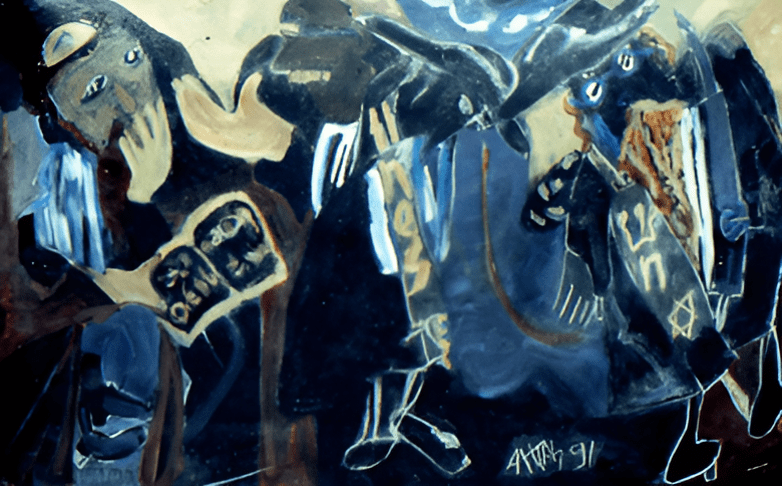
Susana Attías has not shed her proliferating baroque style, but her current production condenses into this type of work, such as those she shows us on this occasion. They are compact, powerful, and more expressionistic images.
Her rabbis and other characters in dark suits and hats remain full of color nuances, semi-merged into the dark planes, and very strong, seemingly compulsive strokes. And the discreet presence of some kind of humor is not uncommon. These characters, which indirectly evoke the theme of religion, are treated with nonchalance and sympathy, not without humor, rather than solemnity. But they are not light images, but dense ones, loaded with affective connotations. In short, with this exhibition, Susana Attías confirms the validity of her creative talent.
Perán Erminy. October 1993

 Susana Gordon